

Heritage Homes: Navigating a Complex Building Insurance Valuation
If you own a Federation bungalow, a sandstone cottage or a Victorian terrace, you’ve probably had a quote for building insurance that felt oddly low. The insurer’s online calculator asked for your postcode, floor area and number of bedrooms. It didn’t ask about the slate roof, the pressed-metal ceilings or the cedar joinery.
That gap matters. If your home is badly damaged by fire, storm or flood, the sum insured is what you have to rebuild with. For heritage homes, a tailored rebuilding cost assessment can help identify specialist restoration costs that a standard insurance calculator may overlook.
This article explains how a building insurance valuation works for heritage properties, why they’re harder to price than a standard house, and what you can do to avoid being underinsured.
Summary
A heritage home can’t be insured on the same basis as a modern house. Rebuilding one usually means specialist trades, traditional materials, heritage approvals and often a longer rebuild period. A standard online estimate rarely captures any of this.
A building insurance valuation (also called an insurance replacement valuation) estimates what it would cost to rebuild your home after a total or major loss. It excludes land value and is separate from a market valuation.
For heritage properties, the main factors are:
- Whether the property is heritage listed or sits in a heritage conservation area
- The materials, finishes and craftsmanship that would need to be replaced
- Heritage and council approval requirements, which vary by state and council
- Demolition, debris removal and make-safe costs, including hazardous materials in older homes
- Professional fees and the likely rebuild timeframe
The practical takeaways are to get your sum insured assessed by someone who understands heritage construction, to read your policy wording carefully, and to review the valuation every few years or after any renovation.
Why a Building Insurance Valuation Is Different for Heritage Homes
A building insurance valuation answers one question: what would it cost to rebuild this home, in the same form and quality, if it were destroyed?
For a 2015 project home in an outer suburb, that’s fairly predictable. Materials are standard, trades are readily available and the design is repeatable. For a heritage home, rebuilding is rarely that simple.
Replacement cost isn’t market value
Many owners assume that a home worth $3 million on the market needs $3 million of cover. It doesn’t work that way.
| Market value | Insurance replacement value | |
| What it measures | What a buyer would pay | What it costs to rebuild |
| Includes land? | Yes | No |
| Driven by | Location, demand, condition, character | Construction cost, materials, labour, approvals |
| Heritage effect | Often a premium for character | Often a cost premium for materials and skills |
A terrace in Paddington or Carlton might carry a very high land value but have a modest building footprint. Another heritage home in a regional town might have a low market value but be expensive to rebuild because of its materials and detailing. This is why market value and rebuild cost can move in opposite directions, even when the property’s physical features remain unchanged.
Why online calculators fall short
Online sum-insured calculators work from averages. They can’t see:
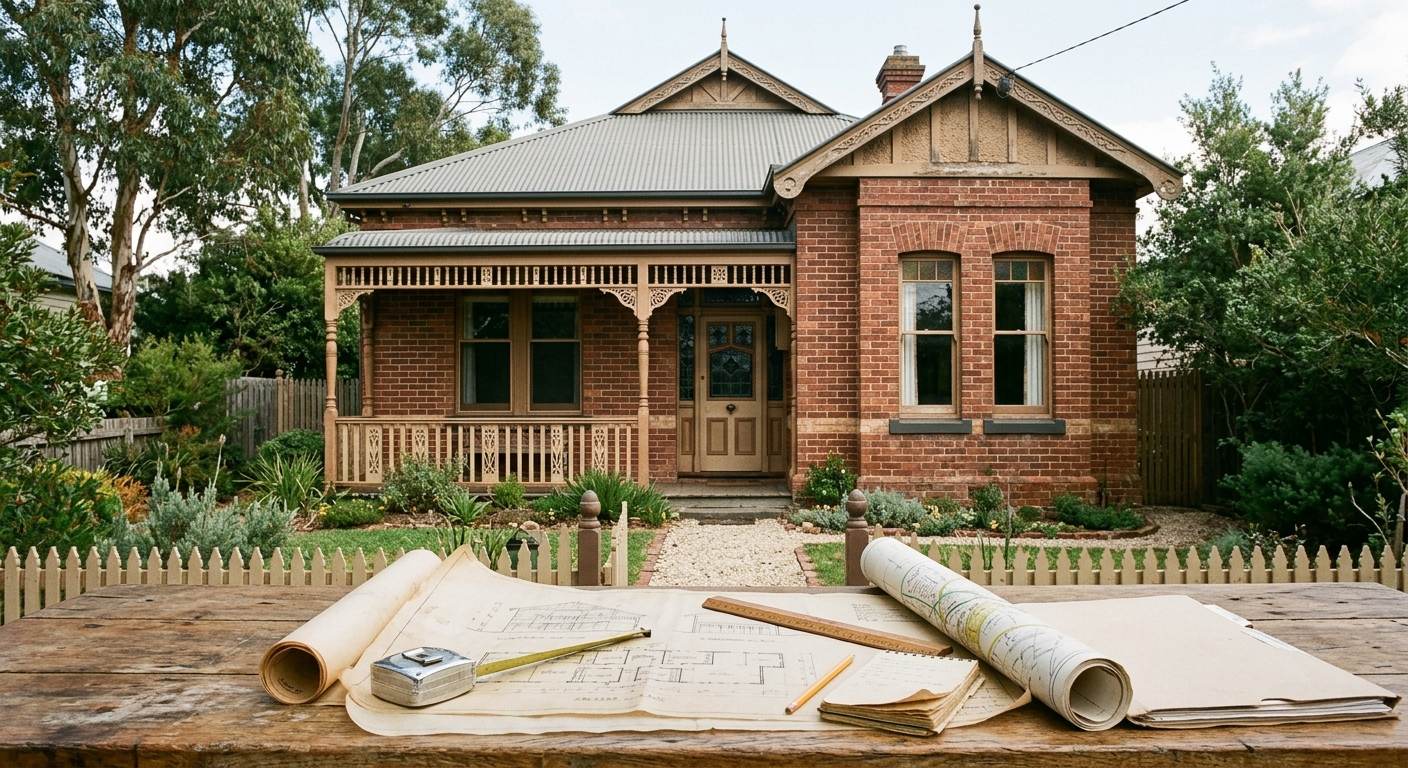
- Hand-cut sandstone or face brickwork with lime mortar
- Slate, terracotta or Marseille tile roofing
- Decorative plasterwork, lath and plaster walls or pressed-metal ceilings
- Timber-framed sash windows, leadlight and cast-iron lacework
Each of these costs more to replace than modern equivalents, and the specialist trades who can do the work may be scarce in your area.
What Makes Heritage Rebuilds So Expensive
Materials and craftsmanship
Reproducing original features often means sourcing reclaimed or custom-made materials. Matching old bricks, replicating timber profiles or recreating ornate plaster cornices takes time and skill. That labour component is usually where the cost gap opens up.
Heritage requirements and approvals
If your home is heritage listed, or sits in a heritage conservation area, you’ll usually need council approval before rebuilding or major repairs, and sometimes a heritage impact statement or advice from a heritage architect.
The framework differs across Australia:
- Local level: councils manage heritage items and conservation areas through planning controls, such as Local Environmental Plans in NSW and heritage overlays in Victoria.
- State level: each state and territory has its own heritage legislation and register, and the rules for what you can and can’t do differ.
- Commonwealth level: a small number of places are on the National Heritage List, with separate federal requirements.
Check which layers apply to your property, because the approval path (and the cost) depends on it.
Demolition, make-safe and hazardous materials
Before any rebuild starts, there’s clean-up. Older homes may contain asbestos in eaves, fibro sheeting or old flooring, and lead-based paint is common in pre-1970s houses. Safe removal and disposal adds cost and time. Heritage homes may also need careful salvage of original elements, rather than simple demolition.
Professional fees and rebuild time
Architects, engineers, heritage consultants and certifiers all add to the bill. Heritage rebuilds also tend to run longer, which matters if your policy limits how much it pays for temporary accommodation.
How a Building Insurance Valuation Works for a Heritage Property
A proper insurance valuation is usually done by a valuer or quantity surveyor who understands construction costs. For a heritage home, the process typically looks like this:
- Collect information. This includes plans where available, renovation history, heritage listing details and any conservation or council requirements.
- Inspect the property. Floor areas are measured and key features, construction methods and condition are recorded, often with photographs.
- Cost the rebuild. The cost is built up from labour, materials and the specialist work needed, then adjusted for approvals and professional fees.
- Add the extras. Demolition, debris removal, make-safe work and consultants’ fees are included.
- Prepare the report. The report sets out the replacement cost, assumptions and exclusions, so you can take it to your insurer.
The result should reflect how your home would realistically be rebuilt, not how a modern equivalent would be built.
Common Misconceptions About Heritage Home Insurance
“Heritage listing means my insurer must restore it exactly.”
Not necessarily. What your insurer will pay for depends on your policy. Some policies replace like for like, others replace with modern equivalents. Many have limits or exclusions for heritage features. Always read the Product Disclosure Statement.
“My sum insured is fine because my premium is reasonable.”
A low premium can simply mean a low sum insured. Underinsurance is common in older homes, particularly those that have had renovations or haven’t been revalued in years.
“Heritage homes can’t be insured.”
Most can, but you’ll usually need to tell your insurer about the heritage status. Some insurers decline or refer these properties, and specialist cover may be worth looking at.
When to Get Your Heritage Home Valued for Insurance
An insurance valuation is worth considering when:
- You’ve bought a heritage property and aren’t sure the existing sum insured is adequate
- You’ve renovated, restored or extended
- It’s been a few years since your last valuation, since building costs can shift quickly
- Your insurer has asked for supporting documentation
- You manage a heritage-era strata building, such as an art deco block. In NSW, owners corporations should generally obtain a replacement valuation every two to five years, in accordance with NSW Government guidance. This is a recommended interval, not a mandatory five-year valuation requirement; other states and territories have different rules.
- You’re an investor or asset manager with older stock in your portfolio
Practical Tips for Heritage Homeowners
- Keep a record. Photograph original features, and keep invoices for restoration work and any heritage advice.
- Be upfront with your insurer. Disclose heritage status and special features.
- Check the policy wording. Look at how it treats like-for-like replacement, heritage materials, compliance with building laws and temporary accommodation.
- Review the sum insured regularly. Don’t leave it on autopilot at renewal.
- Ask who prepared the valuation. For heritage homes, experience with older construction matters.
FAQs
Does heritage listing change my building insurance valuation?
It can. Heritage status may mean approvals, specialist materials and extra consultants, all of which can lift the rebuild cost compared with a similar non-heritage home.
How often should I update the building insurance valuation on an older home?
There’s no single rule for private homeowners, but many people review it every one to three years and after any renovation. Strata schemes have set requirements that vary by state.
Is a building insurance valuation the same as a market valuation?
No. A market valuation estimates what the property would sell for and includes land. An insurance valuation estimates the cost of rebuilding the structure.
Can I rely on my insurer’s online calculator?
For a standard modern home, it may be a reasonable starting point. For heritage homes it often misses the cost of materials, labour and approvals.
What if my home is in a heritage conservation area but isn’t individually listed?
Local planning controls may still affect how you can repair or rebuild, so it’s worth having that reflected in the valuation.
Will the valuation guarantee my insurer pays that amount?
No. It supports your sum insured, but any payout depends on your policy terms, limits and exclusions.
Conclusion
A heritage home isn’t priced like a standard house, and neither is its rebuild. Materials, craftsmanship, approvals and hazardous-material removal all affect cost, and online estimates rarely capture them. A building insurance valuation prepared with heritage construction in mind helps you set a realistic sum insured, so a major loss doesn’t become a major shortfall.
Need a hand with your heritage property?
Australian Insurance Valuations prepares building replacement and reinstatement valuations for residential, strata and commercial properties, including older and heritage-listed buildings. If you’d like an independent estimate to take to your insurer, call us on +61 438 080 786 for a no-pressure conversation.